What's the itinerary?+
• Pickup is available from any location within Agra, which can include hotels, railway stations, airports, restaurants, or any preferred address.
• Visit Fatehpur Sikri with access to all areas and an English-speaking guide included.
• The Shahi Darwaza Gate at Fatehpur Sikri was the main royal entrance for the emperor and his court, showcasing an impressive structure and intricate carvings that highlight Mughal authority and prestige.
• The Turkish Sultana’s House, featuring Indo-Turkish architecture, is embellished with elegant arches and intricate details. It once served as the residence of the Sultan’s consort, embodying both grace and royal elegance.
• The Panch Mahal in Fatehpur Sikri is a five-story pavilion with open pillars, designed for leisure and catering to royal women. Its airy design provides expansive views and exemplifies Mughal beauty.
• The Buland Darwaza, constructed by Akbar in 1601, is a monumental entrance commemorating his victory over Gujarat. Reaching 54 meters in height, it stands as a prominent example of Mughal architecture.
• The Khazana, or Treasury, consists of three rooms that were likely used for storing imperial gold, silver, and confidential documents, though often misnamed Ankh Michauli. Its sturdy rubble walls feature hidden recesses and containers, hinting at secure storage. Distinct features include corbel-supported struts with serpentine scrolls, inspired by Jain temple designs.
• The Caravan Sarai near Hiran Minar served as an inn for merchants and their caravans, emphasizing the city’s importance as a center of trade and culture.
• The Fort Wall of Fatehpur Sikri spans nearly 6 kilometers, enclosing the impressive Mughal city constructed from red sandstone, serving both defensive purposes and as a majestic perimeter for Akbar’s capital.
• The Diwan-i-Aam at Fatehpur Sikri was where Akbar addressed public issues, featuring a large courtyard and pillar design that emphasizes openness and imperial authority.
• Hathi Pol, or Elephant Gate, was a grand entrance into Fatehpur Sikri, designed wide and strong enough for royal elephants, symbolizing power and imperial stature.
• The Hiran Minar is a tall monument erected by Akbar in honor of his favorite elephant, showcasing a unique design that serves as a notable symbol of Mughal respect for animals.
• This rectangular area with elongated arcaded porches is commonly believed to be stables, though its location near Jodha Bai’s Palace raises questions about this assumption.
• Birbal Bhavan, close to Jodha Bai’s Palace, is a well-constructed residence characterized by elegant carvings and symmetrical design, believed to have housed Akbar’s trusted minister Birbal, reflecting Mughal artistry.
• The Tomb of Sheikh Salim Chisti is an exquisite structure made of white marble and adorned with precious gems and stones.
• The Jama Masjid at Fatehpur Sikri is among India’s largest mosques, constructed by Akbar in 1571, notable for its grand architecture and intricate Persian-inspired decorative elements, showcasing Mughal elegance.
• Jodha Bai’s Palace at Fatehpur Sikri features a blend of Rajput and Mughal architectural styles, with expansive courtyards and richly carved motifs built for Akbar’s queen, symbolizing royal splendor and cultural unity.
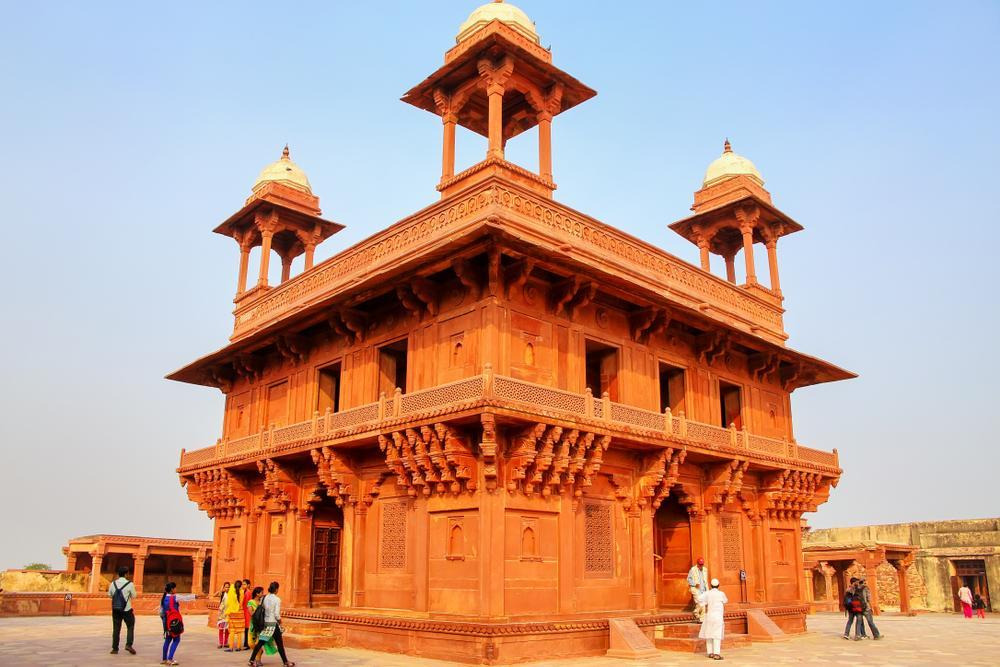
• The Diwan-i-Khas is distinguished by its central intricately carved pillar with radiating stone bridges, representing Akbar’s vision of unity. This notable hall was used for private meetings and discussions related to philosophy and religion.
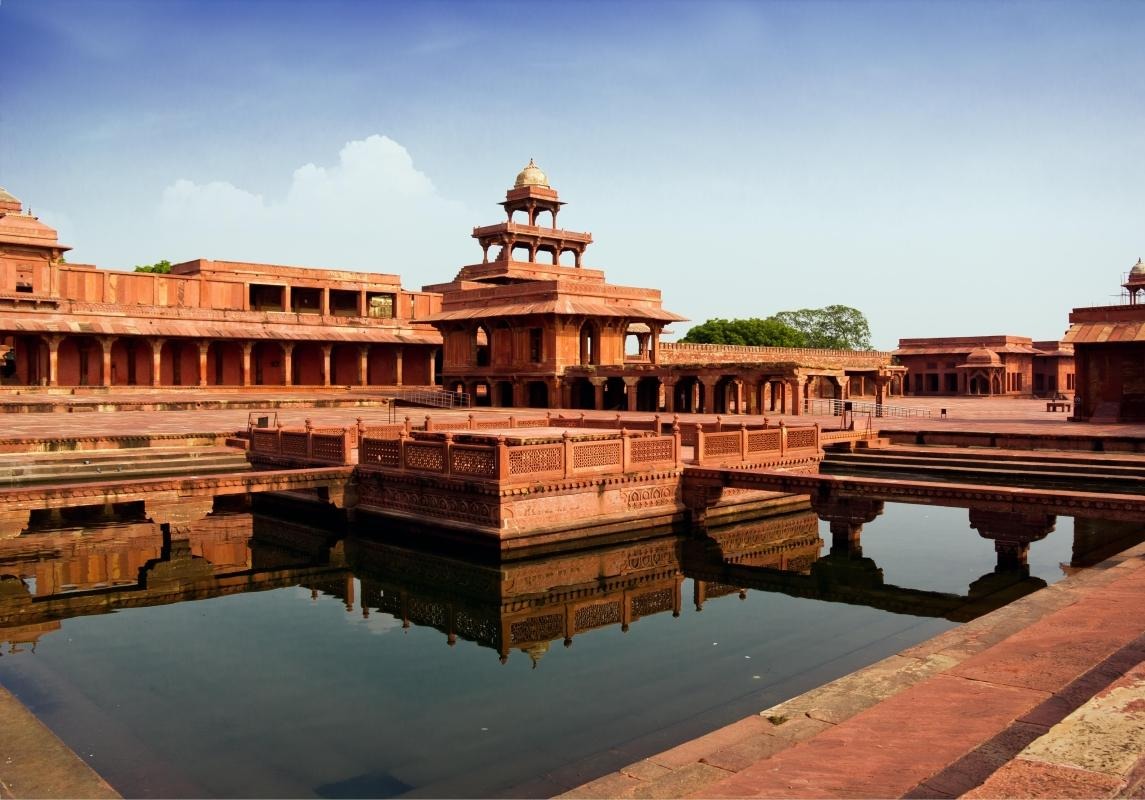
• The Anup Talao is a beautifully ornamented pool in Fatehpur Sikri, surrounded by lovely pavilions, which was utilized for musical performances and royal events, enhancing the grandeur of Akbar’s court.
• The Khwabgah, or “House of