rovostays·

Private tour from Puducherry to Mahabalipuram's Shore Temple

5.0· 3 reviews8 hoursFrom INR 9822
Private tour from Puducherry to Mahabalipuram's Shore Temple — Cultural & heritage things to do in Pondicherry

Full-day private car tour: explore Mahabalipuram's rock-cut temples and landmarks, including lunch and guide.

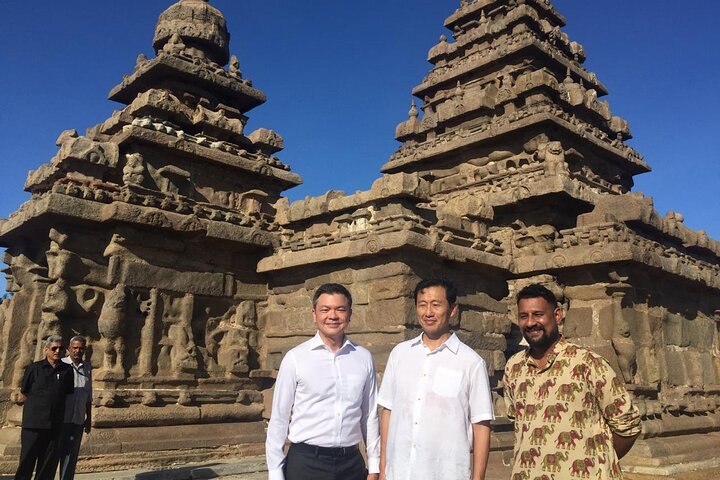
This private tour from Puducherry to Mahabalipuram showcases the ancient rock-cut temples of a UNESCO World Heritage Site. You will travel in a private car, allowing for flexibility throughout the day. Highlights include the iconic Shore Temple, Arjuna's Penance rock relief, the Five Chariots temple complex, and the remarkable Krishna's Butterball.

The tour includes pick up and drop off from your location in Puducherry, an English-speaking guide, and lunch during your visit. You'll spend the day immersing yourself in the history of this coastal town, which served as an important seaport in antiquity. Expect a full day of exploration, so wear comfortable clothing and prepare for fascinating insights into the region's architectural heritage.

FAQ

Good to know

What's included in this experience?+
• Pickup and drop-off service from the hotel in Chennai • Lunch provided • Admission fees included • Tour guide with professional experience
What's NOT included?+
• Drinks
What should I know before booking?+
• Nearby public transport is accessible • Appropriate for all levels of physical fitness
What's the cancellation policy?+
To receive a full refund, cancellations must be made at least 24 hours prior to the scheduled departure.
How does pickup work?+
Pickup is available from any hotel in Pondicherry.
What's the itinerary?+
• The first stop is at the Pancharathas, known as the five chariots, which are a group of rock-cut monolithic temples established by the Pallavas in the 7th century. Each of these five rathas is dedicated to a character from the Mahabharata epic: Draupadi, Arjuna, Nakul-Sahadeva, Bhima, and Yudhister. Adjacent to Nakul-Sahadeva's ratha is a sculpture of an elephant, which bears a striking resemblance to the rear of the chariot when viewed from behind the elephant. • Next, the itinerary includes a visit to Arjuna’s Penace, a significant bas-relief monument recognized as one of India's finest ancient art pieces, showcasing dramatic scenes from the Mahabharata. This relief measures 100 feet in length and 45 feet in height, illustrating how Arjuna, one of the Pandava brothers, underwent rigorous austerities to acquire a weapon from Lord Shiva. • The next destination is the Pandava cave, the largest cave-temple in Mahabalipuram, supported by six pillars and two pilasters. Key architectural features include impressive sculptures of mythical Yali creatures on the pillars. • Following this, the tour proceeds to Krishna’s Butterball, a large granite boulder sitting on a stony incline. This unusual boulder appears to challenge the laws of physics, having remained in this precarious position without shifting for over a thousand years. • The Varaha cave, carved from a massive granite block and dating back to the 7th century, is the next stop. It took many years to complete, featuring squatting lions as decoration on the supporting pillars and sculptures of two guardian angels watching over the sanctum. • This cave exemplifies the remarkable architectural style of the Pallavas, featuring a rock-cut temple dedicated to the Hindu deities of Brahma, Vishnu, and Shiva. The temple also showcases intricate carvings of elephants. • The itinerary includes a visit to an imposing chariot hewn from a single rock, originally devoted to Lord Shiva but now housing an idol of Lord Ganesh. Constructed in the 7th century by King Mahendravarman I, it features 18 inscriptions in ancient grantha and nagari Sanskrit scripts. • Constructed in 640, this lighthouse is the oldest in India and among the oldest globally. Given Mahabalipuram's status as a busy port since the 7th century, the lighthouse played a crucial role in ensuring the safety of maritime navigators. • Within this cave lie two significant pieces of art from Mahabalipuram. The cave walls display two large bas-reliefs: one of Lord Vishnu reclined atop serpent coils and the other depicting Goddess Durga battling the demon Mahishasura on a lion. • The final stop is the Shore Temple, which overlooks the Bay of Bengal. This noteworthy temple served as a key site during the Pallava reign when Mahabalipuram was their principal port. Built by King Raja Simha in the early 8th century, the Shore Temple is a prominent architectural landmark in India, historically referred to by Marco Polo as the seven pagodas. It is the only remaining temple of the original seven that served as a guiding landmark for sailors.

Visiting Pondicherry?

Stay with Rovostays

Hand-picked, verified serviced apartments — concierge always included.