rovostays·

Custom full-day sightseeing tour of Mysore with a guide

5.0· 2 reviews8 hoursFrom INR 12474
Custom full-day sightseeing tour of Mysore with a guide — Cultural & heritage things to do in Mysore

Eight hours of tailored sightseeing in Mysore — explore historical sites and landmarks in air-conditioned transport with a local guide.

This private full-day tour offers a customized exploration of Mysore, recognised for its rich cultural and historical significance. You'll spend about eight hours in air-conditioned transport, visiting various landmarks, from impressive forts to stunning religious sites.

A professional guide accompanies you, sharing insights that enhance your understanding of the city's architectural beauty and historical context. Take note of the cultural fabric that defines Mysore as you weave through its well-planned streets. Be ready for an engaging day that combines history and modernity in this quintessentially Indian city.

FAQ

Good to know

What's included in this experience?+
• Bottled water (available in the tour vehicle) • Pickup and drop-off at the hotel • Local guide • Bottled water • Private tour • Transportation in a private air-conditioned vehicle
What's NOT included?+
• Admission fees for monuments • Tips • Meals and beverages
What should I know before booking?+
• Infants and young children are permitted to be in a stroller or pram • Nearby public transport options are accessible • Appropriate for individuals of all fitness levels
What's the cancellation policy?+
For a complete refund, cancellations must be made at least 24 hours prior to the scheduled departure time.
How does pickup work?+
Complimentary pick-up and drop-off is provided from any hotel, vacation rental, or guest house located within Mysore/Mysuru city. A supplement fee applies for airport pick-up and/or drop-off.
What's the itinerary?+
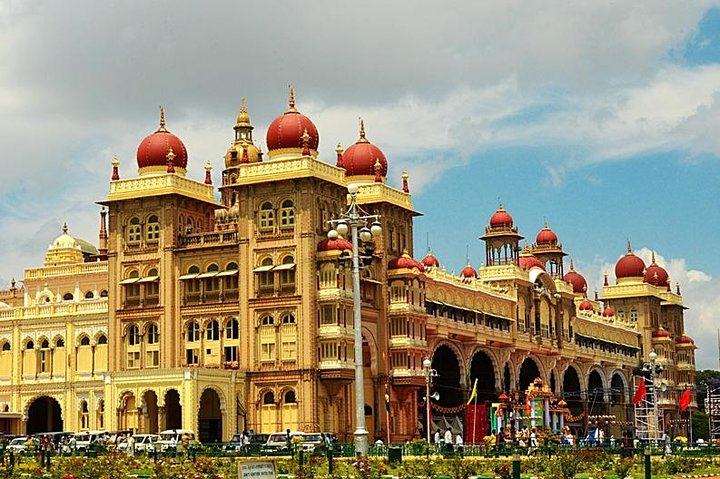
• The Palace was constructed in 1912, costing Rs.41.50 lakhs, in an Indo-Saracenic architectural style that features both Hindu and Saracenic elements. Its construction began in 1897 after an accidental fire destroyed the previous wooden palace. The architect was Henry Irwin, with E.W. Fritchley as the consulting engineer. The elevation showcases a variety of intricate details, including rounded and slightly carved arches, canopies, slender columned colonnades featuring some Hindu design in Rajput style, elaborate mouldings, marble architraves, a stained glass pavilion, durbar halls, panels, and fine carvings depicting birds, foliage, and animals in the Hoysala style. The palace remains closed one day each year, specifically on the day of the Dussehra Procession. Opening hours are daily from 10 am to 5:30 pm. • The island fortress of the historic Warrior-King Tipu Sultan, Srirangapatna, is located just 16 km from Mysuru city. The River Kaveri surrounds the town on all sides, creating a unique impenetrable fortress. Within the fortress are significant sites including Tipu's mosque with twin minarets, the famous Ranganatha Swamy Temple, Tipu's Summer Palace, the Wellesley Bridge, and the dungeons where British officers were held captive. Notable as well is the grand white-domed Gumbaz, featuring ebony doors inlaid with ivory and decorated with Tipu's tiger-striped emblem. Tipu's Summer Palace (Daria Daulat Bagh) is approximately 1 km east of the fort, surrounded by a picturesque garden. The Nimishambha Temple, dedicated to an incarnation of Mother Parvathi, is situated about 2 km from the town. The Wellesley Bridge, built by Dewan Poorniah in 1804 and named after Governor General Marquis of Wellesley, highlights the capabilities in infrastructure development of that era. • Daria Daulat Bagh is a palace located in Srirangapatna, near Mysore in southern India, primarily constructed from teakwood. Srirangapatna is an island formed by the River Kaveri, situated around 14 km from Mysore. The Dariya Daulat Palace is surrounded by lovely gardens, known as Daria Daulat Bagh. • Chamundi Hills serves as a prominent landmark in Mysuru city, visible from almost any location in the city center. The hill is closely tied to the city's history. According to mythology, it was the territory of the demon Mahishasura, which led to the area being known as Mahishapura or Mahishuru, the home of Mahishasura. This name eventually evolved into Mysore in English and Mysuru in Kannada, the regional language.

Visiting Mysore?

Stay with Rovostays

Hand-picked, verified serviced apartments — concierge always included.