What's the itinerary?+
• Kanyakumari, situated at the southernmost point of mainland India, is a stunning coastal town in Tamil Nadu where the Arabian Sea, Bay of Bengal, and Indian Ocean meet. It is noted for its spiritual importance, scenic beauty, and cultural depth, providing a singular experience found nowhere else in India.
• The Kanyakumari Amman Temple, also referred to as the Devi Kanya Kumari Temple, is a significant shrine located at this southernmost point. This temple, dedicated to Goddess Kanya Kumari, represents an adolescent aspect of Parvati, embodying purity, devotion, and spiritual vigor.
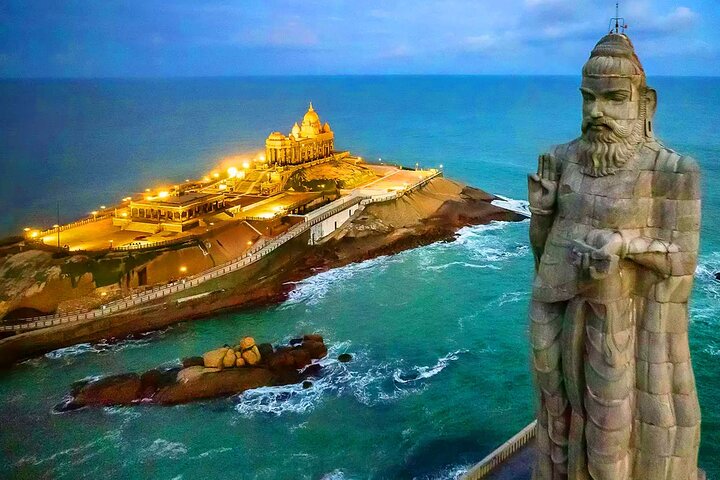
• The Vivekananda Rock Memorial is one of India's highly revered and iconic monuments, situated on a small island off Kanyakumari's coast. Constructed in 1970 to honor Swami Vivekananda, this imposing structure stands at the location where he reportedly meditated and achieved enlightenment in December 1892, prior to disseminating Vedanta philosophy in the West.
• The Thiruvalluvar Statue is a grand monument honoring the famous Tamil poet and philosopher Thiruvalluvar, known for his ancient work Tirukkural — a compendium of 1,330 couplets addressing ethics, politics, love, and morality. Positioned on a rocky island nearby, this towering statue is among the tallest in India and symbolizes Tamil culture and intellect.
Significance:
Thiruvalluvar's Tirukkural is viewed as an enduring guide to ethical living, transcending cultural and linguistic boundaries. The statue pays tribute to his impact on Indian literature and philosophy, representing universal principles.
• The sunset at Kanyakumari is a remarkable experience within South India. It is the only region in India where both sunrise and sunset can be observed over the ocean, providing a truly extraordinary and spiritual occurrence at the southernmost tip of the Indian mainland.
Highlights:
The Triveni Sangam – where the Arabian Sea, Bay of Bengal, and Indian Ocean intersect – showcases a vibrant array of colors during sunset.
On clear nights, the sun seems to descend into the expansive ocean horizon, resulting in golden-orange skies fading into dusk.
This location is a favored spot for tourists, photographers, and pilgrims seeking tranquility and natural beauty.
• The Gandhi Memorial Mandapam in Kanyakumari is a tranquil and respectful structure dedicated to Mahatma Gandhi, established where his ashes were kept before being immersed in the sea. It is positioned near the confluence of the Arabian Sea, Bay of Bengal, and Indian Ocean, making it both historically important and architecturally distinctive.
Significance:
Following Mahatma Gandhi’s assassination in 1948, a portion of his ashes was placed here for public tribute before immersion in the sea. The Gandhi Mandapam was subsequently constructed in his memory, with its inauguration in 1956.
• The Triveni Sangam in Kanyakumari is a notable and sacred site where the three major water bodies — the Bay of Bengal, the Arabian Sea, and the Indian Ocean — meet. This location marks the southernmost point of mainland India and is revered for its spiritual and cultural importance.
Spiritual Significance:
In Hindu customs, the convergence of three rivers or seas is referred to as a “Sangam,” considered a highly sacred location for rituals and purification. At Kanyakumari, the Triveni Sangam symbolizes the unity of three divine waters and attracts pilgrims from across India.
Visitors believe that bathing here eliminates sins and offers spiritual rewards. Although the waters can be turbulent at times, many individuals choose to wet their feet and say prayers by the shore.
• The Thanumalayan Temple in Suchindram, located merely 13 km from Kanyakumari, is a distinctive Hindu temple dedicated to the Trimurti – Brahma (Tha), Vishnu (Numa), and Shiva (Layan). It is one of the few temples in India where followers of all three principal deities of