What's the itinerary?+
• Hanuman Garhi, located in Ayodhya, Uttar Pradesh, embodies devotion and strength. This ancient temple dedicated to Lord Hanuman draws pilgrims with its peaceful atmosphere and melodic hymns. The architecture, featuring tall spires and detailed carvings, represents India's cultural richness. Inside the sanctum, the idol of Lord Hanuman radiates divine grace, providing comfort to worshippers. Nearby shrines illustrate scenes from Hindu mythology, where prayers for health and prosperity are offered. Hanuman Garhi symbolizes steadfast faith, inspiring awe and reverence in visitors.
• kanak maharaj ki jai
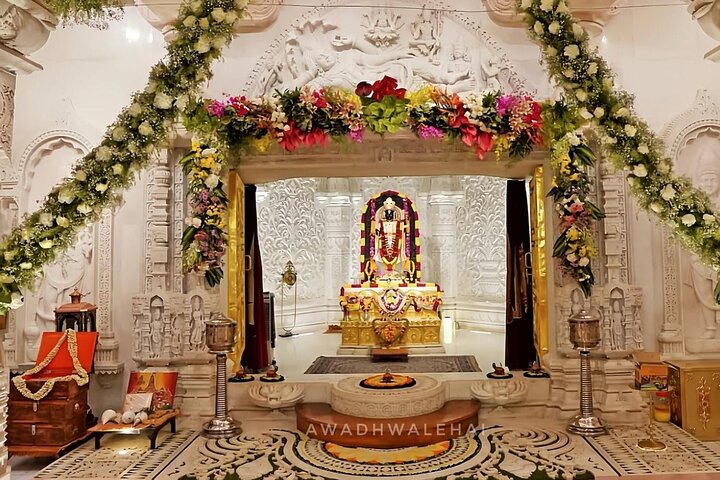
• The Ram Janmabhoomi temple in Ayodhya, Uttar Pradesh, is a significant religious and cultural site, deeply rooted in Hindu mythology and history.
At its center lies the sanctum sanctorum, which contains the deity of Lord Rama and other revered figures from the Ramayana. The temple attracts numerous devotees, who come to pray, seek blessings, and immerse themselves in the spiritual atmosphere of the sacred grounds.
• This historical location is believed to have been the palace of King Dashrath, the father of Lord Rama, and carries great mythological importance. It reflects the royal lineage and heroic tales from the Ramayana, providing insight into both the epic's splendor and Ayodhya's royal heritage.
• Valmiki, the author of the Ramayana, is thought to have resided in Ayodhya. The place associated with his time there is known as Valmiki Bhavan. This building has historical significance and is a vital part of Ayodhya’s cultural and spiritual legacy, recognized since ancient times. Ayodhya, an ancient city rich in legends, boasts numerous holy sites, including Valmiki Bhavan, an important location linked to the great sage.
• Sita Ki Rasoi in Ayodhya is regarded as the kitchen of Sita, Lord Rama’s wife, and is essential for those interested in Hindu mythology. Visitors can explore a small temple which contains ancient utensils believed to have belonged to Sita.
• Sarayu Ghat in Ayodhya Dham, Uttar Pradesh, is a sacred spot along the River Sarayu, recognized for being the birthplace of Lord Rama. It is a significant site for pilgrims, where ritual baths (\"Snan\") in the river's waters are thought to cleanse sins. This picturesque ghat invites pilgrims to partake in rituals, prayers, and aarti ceremonies, creating a spiritually enriched environment. Temples, ghats, and ashrams line the banks, further enhancing its religious significance. Aarti is included.
• It is also said that before his 14-year exile, Lord Rama bathed in the sacred waters of Saryu at this location. "Ram Ki Paidi" translates to "Ram's stairs" or "Ram's ghats," referring to a series of steps leading into the Saryu River in Ayodhya, where devotees immerse themselves in the holy waters.
• The temple located at Ram Ki Paidi in Ayodhya is dedicated to Nageshwarnath, believed to have been established by Kush, the son of Rama. According to legend, Kush lost an armlet while bathing in the Saryu, which was found by a Nag-Kanya who fell in love with him. Being a devotee of Shiva, Kush built this temple for her. The temple remained intact until the days of Vikramaditya, and the current structure was constructed in 1750 by Naval Rai, a minister of Safdar Jung. The festival of Shivratri is celebrated here on a grand scale, including the Shiv Barat procession, which is especially significant, drawing thousands of devotees during the Mahashivratri celebrations.